


2026 Ford Bronco vs Jeep Wrangler: Off-Road & Utility Comparison
Few debates in the SUV world run as deep as this one. The Ford Bronco and the Jeep Wrangler both carry serious off-road credentials, loyal fan bases, and the kind of rugged character most SUVs only pretend to have. But picking between them takes more than brand loyalty. You need a real breakdown of what each rig does best and which one actually fits your life. If you’re leaning toward the Bronco, browse our Bronco inventory at Stivers Ford South in Union City, GA.
The 2026 Ford Bronco brings refined capability and a solid suite of modern trail technology. The Jeep Wrangler carries decades of proven performance and a reputation deeply embedded in off-road culture. This comparison is about which vehicle fits different driver priorities, not which one wins some imaginary universal trophy.
Off-Road Capability: Suspension, Ground Clearance, and Trail Hardware
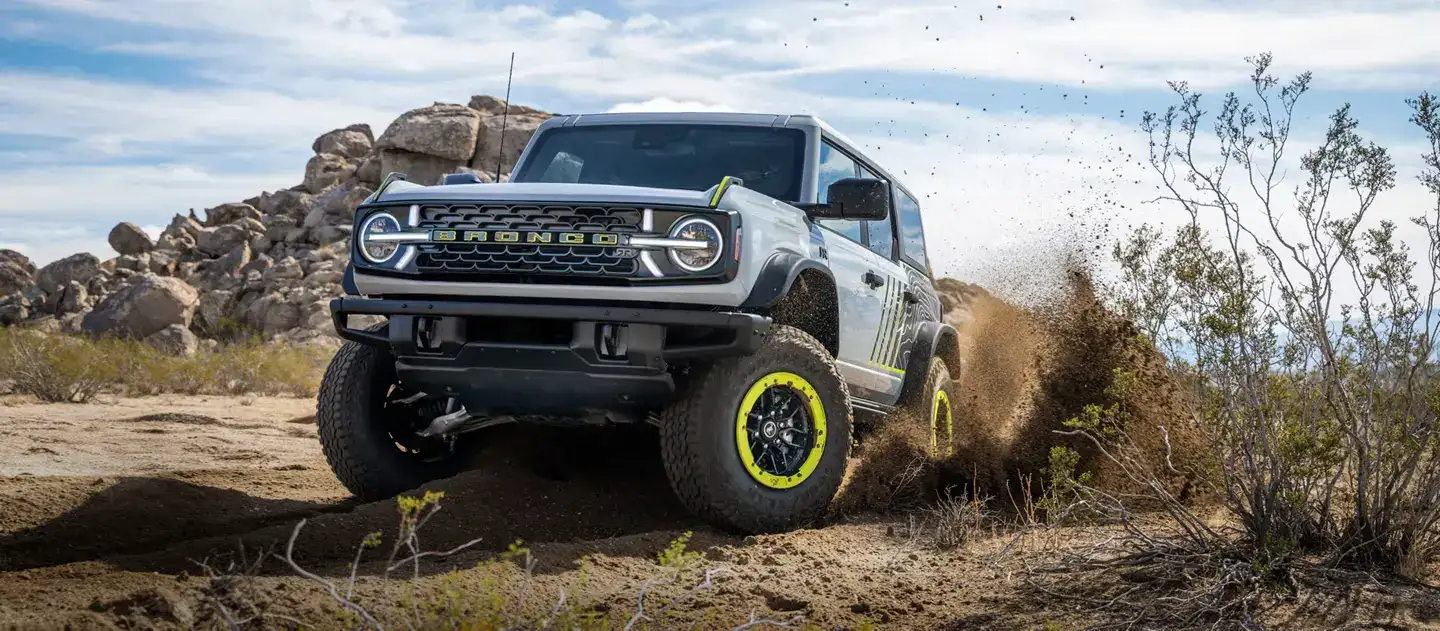
Both SUVs tackle serious terrain with different philosophies but land at similarly capable results. The Bronco leans into adaptability and engineering precision. The Wrangler draws on a long heritage of proven trail performance.
Ground clearance matters a lot when rocks, ruts, and uneven terrain enter the picture. The Bronco offers up to 11.6 inches of ground clearance on the base 4-door, and up to 13.1 inches on the Raptor trim. The Wrangler Sport comes in at 9.7 inches standard.
4×4 Systems, Lockers, and Crawl Control
The Bronco’s G.O.A.T. Modes (Goes Over Any Type of Terrain) give drivers selectable settings tuned for sand, mud, rocks, Baja, and more. The Badlands trim adds front and rear locking differentials and a sway bar disconnect, closing much of the gap between it and the Wrangler Rubicon.
The Wrangler uses Command-Trac on base trims, a part-time system with 2WD, 4H, 4L, and Neutral. Step up to the Rubicon and you get Rock-Trac, which features a 4:1 low-range ratio, Tru-Lock front and rear electronic lockers, and an electronic sway bar disconnect for dramatically increased wheel articulation. For slow-speed technical crawling, the Rubicon’s locker-forward setup remains a genuine benchmark.
Approach Angles and Real-World Trail Performance
Approach, breakover, and departure angles tell you how steep an obstacle a vehicle can handle without dragging. The Bronco’s shorter overhangs contribute to competitive angles across its lineup. Worth noting: confirmed 2026 approach and departure specs for both vehicles are still pending official release, so figures currently in circulation are based on prior model year data.
The Wrangler’s long history also means trails across the country have been mapped and rated with it in mind. That community depth and aftermarket trail support is real and significant, even if the Bronco has closed the performance gap considerably.
Spec Comparison: Key Trim Matchups
| Spec | Bronco Big Bend | Wrangler Sport S | Bronco Badlands | Wrangler Rubicon | Bronco Raptor | Wrangler Rubicon 392 |
| Engine | 2.3L I-4 | 3.6L V6 | 2.3L I-4 | 3.6L V6 | 3.0L V6 | 6.4L V8 |
| Horsepower / Torque | 300 hp / 325 lb-ft | 285 hp / 260 lb-ft | 300 hp / 325 lb-ft | 285 hp / 260 lb-ft | 418 hp / 440 lb-ft | 470 hp / 470 lb-ft |
| Ground Clearance | 8.4 in (11.5 in w/ Sasquatch) | 9.7 in | 11.5 in (13.1 in w/ Sasquatch) | 10.8 in (std) 12.9 in (4-dr w/ Xtreme 35) | 13.1 in | 11.6 in |
| 4WD System | Advanced 4×4 w/ G.O.A.T. Modes | Command-Trac | Advanced 4×4, front/rear lockers, sway bar disconnect | Rock-Trac, Tru-Lock lockers, sway bar disconnect | Advanced 4×4, front/rear lockers | Rock-Trac, Tru-Lock lockers, sway bar disconnect |
| Towing Capacity | 3,500 lbs | 3,500 lbs | 3,500 lbs | Up to 5,000 lbs (4-door, properly equipped) | 4,500 lbs | 3,500 lbs |
EPA fuel economy for the 2026 Bronco’s 2.7L V6 comes in at 19 city / 20 highway mpg. If you’re sorting through trim configurations and want to talk through financing options for a specific build, our team can help you work through the numbers.
Utility: Cargo, Towing, and Open-Air Experience
The Bronco offers a practical interior layout with a washout-ready floor option that makes post-trail cleanup pretty painless. The Wrangler’s upright body shape creates a tall cargo area that handles bulky gear well. Both are functional day-to-day haulers without much complaint.
Towing varies by configuration. Standard Bronco trims top out at 3,500 lbs, while the Raptor raises that to 4,500 lbs. Wrangler 4-door models can tow up to 5,000 lbs when properly equipped, giving them a clear towing edge in comparable configurations.
The open-air experience is a genuine draw on both sides. Removable doors, fold-down windshields, and versatile roof options are available on the Wrangler. The Bronco matches this closely with removable doors and roof panels on both two-door and four-door builds. Honestly, this category is a tie decided entirely by personal preference.
Daily Drivability: Ride, Technology, and On-Road Manners
The Bronco’s independent front suspension delivers a noticeably smoother on-road ride and better highway stability. If your daily drive involves heavy freeway miles or winding roads, that difference is real and consistent.
The Wrangler’s solid front axle communicates more road texture by nature, though it has improved significantly over recent generations. Cabin materials in higher Wrangler trims feel refined and well-assembled. The solid axle remains the preferred setup among dedicated rock crawlers for the articulation it allows, so this is a tradeoff rather than a flaw.
Both vehicles offer modern infotainment with smartphone integration and driver assistance features. The Wrangler’s Uconnect system has earned consistent praise for its intuitive layout. The Bronco’s SYNC system is competitive, with a large touchscreen standard across most trims. Long-term reliability has improved across both lineups in recent model years.
Which Driver Should Choose Each Rig?
Neither vehicle is universally better. The right pick depends on how you drive, where you drive, and what you value most.
The 2026 Ford Bronco Is the Right Pick If…
The Bronco makes the most sense for buyers who want modern trail technology in a versatile, daily-friendly package. If you want a more comfortable, composed ride between trailheads, the independent front suspension delivers it. Buyers drawn to G.O.A.T. Modes, the Sasquatch package’s 35-inch tires, and strong on-road civility will feel right at home. The Raptor’s 4,500-lb tow rating also gives it a practical edge for drivers who tow regularly.
The Jeep Wrangler Makes More Sense If…
The Wrangler is the right call for drivers who value a proven off-road legacy, a deep aftermarket community, and strong resale performance. The Rubicon’s Rock-Trac system, Tru-Lock lockers, and sway bar disconnect give it a distinct advantage for technical rock crawling. Buyers looking for higher towing capacity in a standard configuration, or those planning to hold the vehicle long-term, will also find the Wrangler’s value proposition hard to ignore.
Experience the 2026 Ford Bronco at Stivers Ford South
Visit Us in Union City, GA
Reading specs only goes so far. The best way to understand what the 2026 Ford Bronco actually feels like on a trail or during your daily commute is to get behind the wheel. Stivers Ford South is located in Union City, GA and serves the broader metro Atlanta area with a strong selection of new Ford vehicles, including the full Bronco lineup.
Schedule Your Test Drive
Our team is ready to walk you through available trims, compare configurations side by side, and help you find the right fit for your needs. Reach our team to schedule a test drive or get any questions answered before you visit. The Bronco is one of the most capable and versatile off-road SUVs on the market right now, and experiencing it in person is well worth the trip.
Images by OEM
0 comment(s) so far on 2026 Ford Bronco vs Jeep Wrangler: Off-Road & Utility Comparison