


How to Use Ford Pro Power Onboard: Turning Your Truck into a Mobile Generator
If you’ve ever needed power at a job site or campground without hauling a separate generator, Ford Pro Power Onboard solves that directly from your truck. This guide covers what the system is, how to use it step by step, which models offer it, and the safety practices we recommend every owner follow.
What Is Ford Pro Power Onboard?
Pro Power Onboard turns a truck or van into a mobile power source, sending electricity from the engine or battery straight to outlets in the bed and cabin. It’s a factory system, so the wiring, outlets, and safety protections are engineered in rather than bolted on. Gas trucks use a secondary alternator for the extra output.
PowerBoost hybrids draw from a twin-turbo 3.5L V6 paired with a 1.5-kWh liquid-cooled lithium-ion battery, and once that battery hits its minimum charge, the gas engine takes over automatically. The truck needs to be running or in accessory mode, and it can generate power while driving, so tools are ready the moment you park.
Power Output Varies by Powertrain
Output ranges from 2.0 kW on base gas trucks up to 7.2 kW on the top hybrid configuration, with several tiers in between:
| Powertrain/Model | Max Output | Outlet Count/Type | Notable Use Case |
|---|---|---|---|
| Gas F-150 (2.7L V6, 3.5L V6, 5.0L V8) | 2.0 kW | Dual 120V/20A bed outlets | Small tools, camping lights |
| PowerBoost Hybrid (standard) | 2.4 kW | Two 120V bed outlets | About 85 hours at max wattage on a full tank; deck-building, masonry |
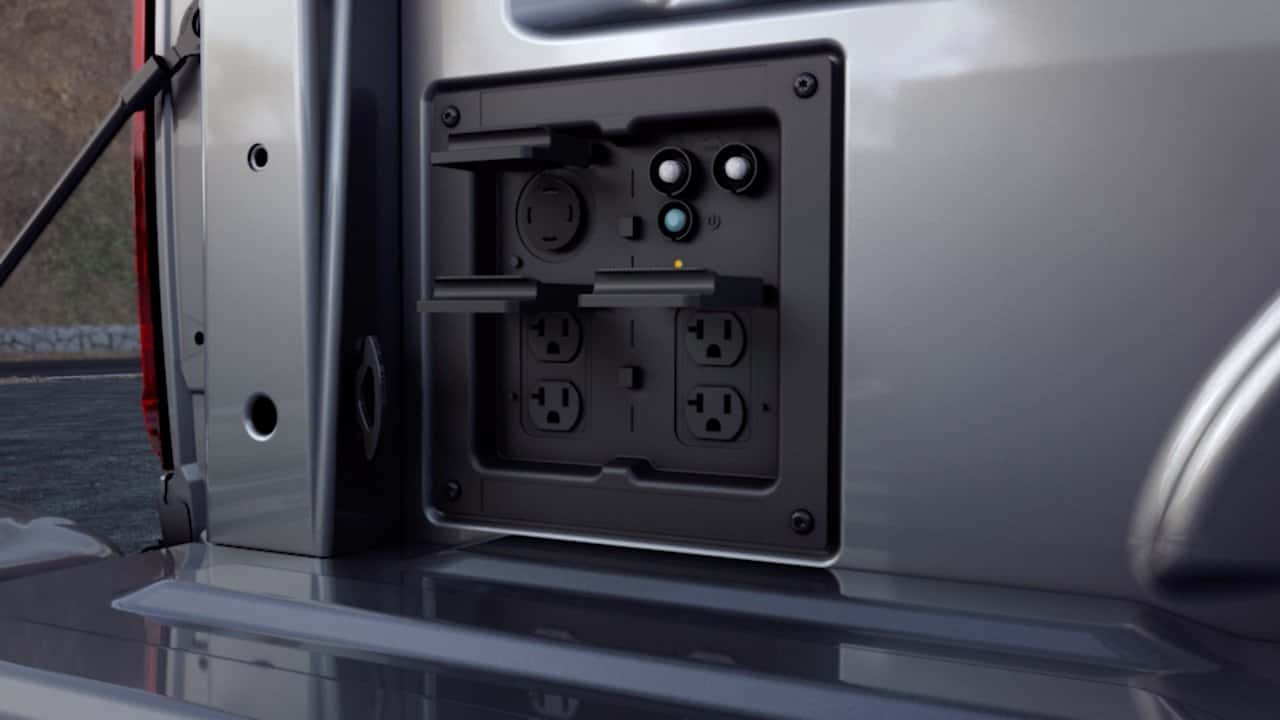
| PowerBoost Hybrid (optional) | 7.2 kW | Four 120V outlets plus one 240V outlet | About 32 hours at max load on a full tank; auto load balancing; powers miter saws, air compressors, full camper rigs |
| Super Duty | 2.0 kW | Two 120V bed outlets | Automatic load balance; drills, lights, vacuums, chargers |
| E-Transit | 2.4 kW | Two outlets on rear cargo passenger sidewall | Mobile cargo and fleet power |
How to Activate and Use Pro Power Onboard
Learning how to use Ford Pro Power Onboard is straightforward once you know where to look. The system is built for quick access whether you’re at a Union City job site or parked at a campground miles from an outlet.
Locating Outlets and the Control Panel
Cabin 120V outlets sit in the instrument panel or console and supply up to 400W, enough for laptops and chargers. The weatherproof panels in the bed handle everything heavier.
Starting the System and Monitoring Load
- Start the truck or switch it to accessory mode.
- On the main display, navigate to Pro Power, then Power, then Generator Mode. Or press the physical Pro Power Onboard button, located on the dash for 2.0 kW systems or above the screen on 2.4 kW and 7.2 kW systems.
- Manually turn on the bed outlets using the physical outlet button; they don’t activate automatically.
- Calculate your load before plugging anything in, using watts = volts × amps, and check it against the gauge display.
- Watch usage on the gauge cluster, which warns you as you approach the wattage limit and alerts you if a breaker trips.
- For remote monitoring, open the Ford app, select your vehicle, and go to the Pro Power Onboard tab. If you’ve had a Ford for a few years, this is the app you know as FordPass, which Ford has since renamed.
If a breaker trips, unplug all connected devices before resetting the system. Never reset it with devices still drawing power.
Available Models and Trims with Pro Power Onboard
Trim level matters here, since not every Ford vehicle offers this feature. Here’s where Pro Power Onboard is available for the 2026 model year, and where it isn’t.
F-150 Trims: Where Pro Power Onboard Starts
Pro Power Onboard is available much further down the F-150 lineup than most shoppers expect. The 2.0 kW system is offered on XLT SuperCrew and above when equipped with the 3.5L EcoBoost V6, and comes standard on Platinum with that engine. The 2.4 kW system is standard on any F-150 with the 3.5L PowerBoost Full Hybrid V6, starting at XLT, and the 7.2 kW upgrade can be added to PowerBoost models for a modest additional cost, with Platinum hybrids including it as standard. The base XL trim doesn’t offer Pro Power Onboard, but you don’t need to reach King Ranch or Platinum to get it.
Super Duty Availability
Super Duty Pro Power Onboard has been available since the 2023 model year across F-250, F-350, and F-450, delivering 2.0 kW through two 120V bed outlets, suited to running drills, work lights, vacuums, and chargers simultaneously. Availability varies by trim and equipment group, so it’s worth confirming the configuration on the specific truck you’re considering rather than assuming it’s included.
Ford E-Transit’s Onboard Power Capability
The E-Transit also carries onboard power capability, delivering 2.4 kW through two outlets on the rear cargo passenger sidewall, a practical choice for fleets and mobile businesses that need reliable power without extra equipment. The F-150 Lightning sits at the top of the range, with 2.4 kW standard and an available 9.6 kW system that splits into two circuits: 2.4 kW serving the cabin and front trunk, and 7.2 kW in the bed.
That configuration adds two 120V cab outlets, four 120V and one 240V outlet in the bed, and two 120V outlets up front, and it’s the only version that can be wired into a home’s electrical system for whole-house backup.
Real-World Applications for Pro Power Onboard
Camping and Outdoor Adventures
A 2.0 kW system handles small tools, a TV, speakers, and camping lights. Step up to 7.2 kW and you can run a full camper rig, air conditioning and fridge included. One caveat worth knowing: 2.0 kW generally won’t start an RV air conditioner, so if that’s your plan, the hybrid tiers are the ones to look at.
Worksite and Jobsite Power Needs
The 2.4 kW tier covers deck-building and masonry work. The 7.2 kW configuration handles framing, industrial saws, and welding equipment straight from the bed, with no separate generator to haul between sites.
Safety Considerations and Best Practices
The main hazard with a portable generator is a combustion unit running at ground level right where people are working. Pro Power Onboard draws from the truck’s own engine and routes exhaust through the vehicle’s system, which removes that. The truck is still running, though, so the CDC’s rule holds either way: never operate it in a garage, basement, or any enclosed space.
Safe operation still requires attention. We recommend keeping this checklist in mind:
- Use only outdoor-rated extension cords, and confirm they’re rated for 20A on 120V outlets.
- Never daisy-chain multiple extension cords together.
- Calculate your total load, accounting for motor startup surge, before adding any devices.
- Never plug home wiring directly into a vehicle outlet.
- If the system overloads, it shuts down automatically; unplug everything before resetting.
As for battery drain, Ford builds in a smart battery protection reserve meant to keep enough charge available to restart the vehicle, though it’s not an absolute guarantee under every condition, so check your owner’s manual for specifics.
If you’re considering using your truck as home backup power, particularly relevant given Union City’s occasional severe weather and outages, that setup typically requires a transfer switch or specific electrical configuration. We’d encourage you to contact our team before attempting that kind of setup.
Experience Pro Power Onboard at Stivers Ford South
Whether you’re outfitting a work truck, planning camping trips, or preparing for outages, Pro Power Onboard adds genuine versatility to your Ford. Now that you know how to use Ford Pro Power Onboard, the next step is finding the trim and configuration that fits your needs.
Our team at Stivers Ford South can walk you through model availability, outlet configurations, and compatibility questions in person. If you’re ready to move forward, explore financing options and let us help you find the right F-150, Super Duty, or E-Transit for your work and your life.
Images by OEM
0 comment(s) so far on How to Use Ford Pro Power Onboard: Turning Your Truck into a Mobile Generator